Finally Fridays: Violence resumes in the Middle East—and in Memphis
The war with Iran is back on, two more are killed by the Memphis 'Safe' Task Force, and as a palate cleanser, my (failed) attempt to become a soccer fan during the World Cup


The Breakdown: The Death of a Fragile Truce with Iran
In case there was any doubt left, President Trump this morning posted explicitly on Truth Social that while the US will continue talks with Iran, "the United States has stated to them, in no uncertain terms, that the ceasefire is OVER!" How we got to this point is a matter of some debate, but there are some key events.
The 14-point Memorandum of Understanding (MOU) signed in Versailles, France on June 17 unraveled less than three weeks into the 60-day negotiating window. Iran claimed the MOU gave it right of management over the Strait of Hormuz and attempted to levy transit fees. The U.S. and regional allies resisted.
There have been some tit-for-tat exchanges over the past few weeks while both sides said they remained committed to the ceasefire.
On July 6 and 7, three commercial tankers transiting the Strait of Hormuz—including the Qatari LNG tanker Al Rekayyat and the Saudi-flagged Wedyan—were struck by drones and missiles.
The Trump administration then revoked the sanctions waiver on Iranian oil exports. U.S. Central Command (CENTCOM) launched back-to-back nights of heavy airstrikes. The first wave hit 80 targets; the second wave hit 90 targets, destroying Iranian radar sites, air defenses, and IRGC naval assets. In all, at least 14 people were killed.
Back-channel negotiations via Pakistan and Qatar continue, even as commercial traffic in the Strait remains at a near-standstill.
The Trump administration is trapped. As Marco Rubio admitted on the first day of the war, the US only entered this ill-advised conflict because Israel forced their hand. And unlike with the fast take-over of Venezuela, attacking a country like Iran is not a quick in-and-out operation.
There’s no indication we are helping the Iranian people break free from tyranny, which has been one point of propaganda from MAGA politicians and supporters. If anything, the Ayatollah’s recent funeral brought millions of Iranians together to mourn a leader many of them were protesting against earlier this year.
With no viable way to declare victory in Iran, the administration now wants to look hawkish to satisfy Israel and conservative media in the US. At the same time, they know a prolonged, hot war with Iran will cause global crude oil prices to skyrocket. And with the midterms fast approaching, Republicans are concerned about the price of gas at the pump in the US.
Trump went into Iran thinking that he could get a quick military victory, without clear objectives or a clear strategy. Bombing the hell out of Iran is not going to win freedom for the Iranians or guarantee regime change. It’s not going to open up the Strait of Hormuz, which was open before Trump started the war, It’s not going to keep Iran from developing a nuclear weapon, which they weren’t doing anyway.
It’s becoming clearer to everyone that continuing the war with Iran isn’t going to benefit the US in any way. The real lesson to learn from this is not that we should attack Iran in hopes of bringing gas prices down a few cents. Poll after poll shows how unpopular the war with Iran is. The American people are tired of our money being used to spread death and destruction abroad. It is time to stop attacking Iran and find a path towards a long-term peace.
Posting through the Madness: After two more fatal shootings, the Memphis “Safe” Task Force is anything but safe
Two more bodies in four days. That’s the death toll of the Memphis Safe Task Force this week alone. While the government is ramping up its offensive war abroad against Iran again, the violence used by authorities domestically continues to rise in our cities, including here in Memphis.
Sunday, July 5: Two Tennessee National Guard members, assigned to the Memphis Safe Task Force, shot and killed 20-year-old Tyrin Johnson during a foot pursuit downtown.
The authorities claim that Johnson turned toward them with a firearm, but as of Friday morning, still no footage has been released. Johnson was a father and leaves behind a young child. His family states he was shot twice in the chest and is calling for the release of video evidence.
The fact that they still haven’t released video of the incident raises suspicion about the official account of events. Tyrin Johnson’s grandfather’s public plea “Show me the video” so far has gone unanswered.
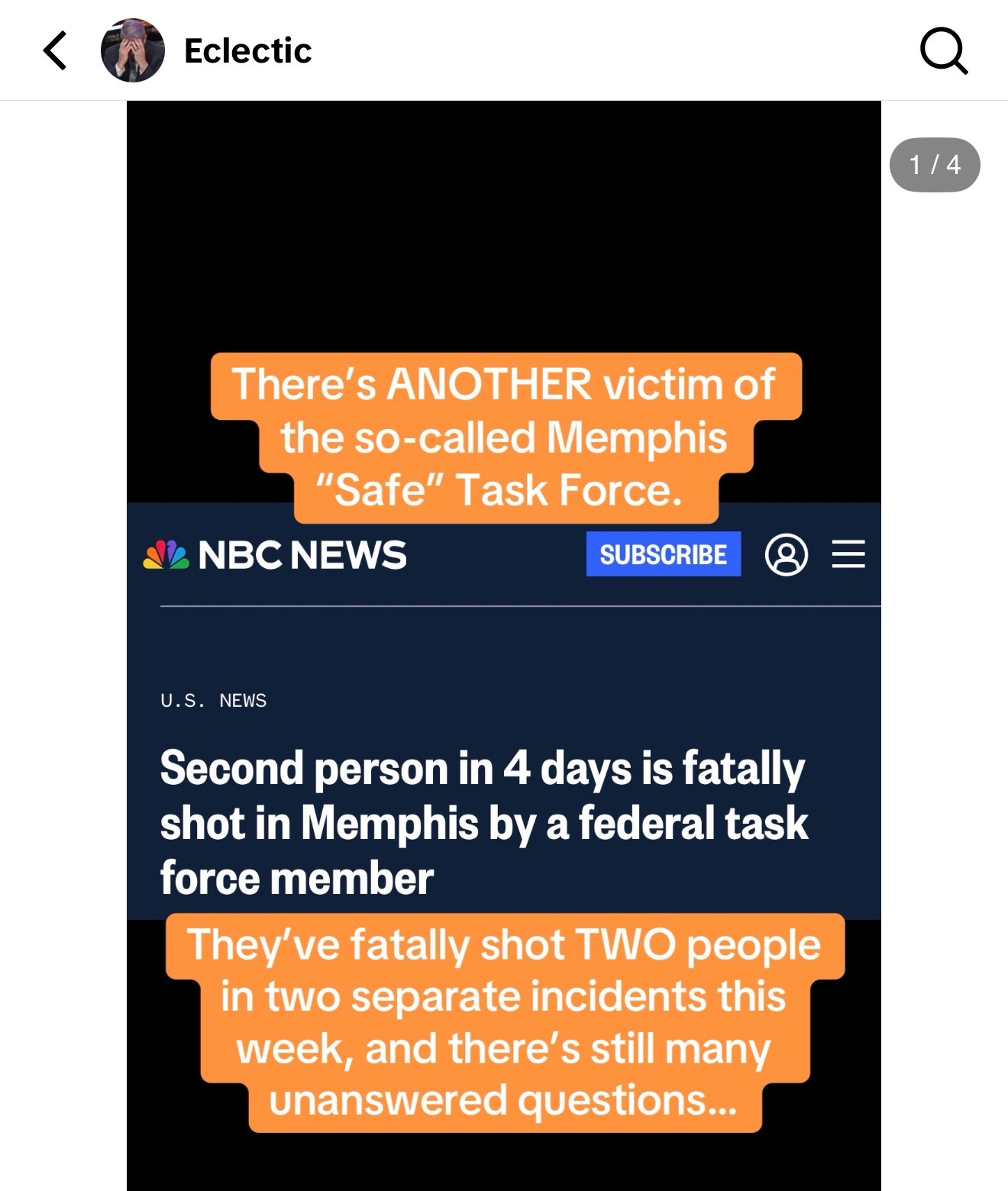
My TikTok post about the Memphis Safe Task Force Wednesday, July 8: A DEA agent shot and killed 47-year-old Alfonso Ivy at the Extended Stay America hotel on Poplar Avenue in East Memphis.
Authorities say they were serving a felony drug warrant. After Ivy allegedly refused to open the door, task force members breached the room.
The rest of what happened remains unclear. U.S. Marshals claim Ivy pointed a handgun. The Tennessee Bureau of Investigation (TBI), on the other hand, issued a vaguer statement later noting only that a DEA agent "fired into a room" and not mentioning Ivy having a handgun.
It is unclear if footage of the incident even exists since DEA agents, thanks to a Trump directive, no longer need to wear body cams.

With at least two other deaths we know of so far since the Memphis Safe Task Force started in September 2025, the fatal shootings this week are not an isolated police blotter anomaly. When you deploy a federalized military presence in city neighborhoods, state violence is inevitable. It is the predictable consequence of a hyper-militarized, Frankenstein force of local, state, and national agents pieced together to operate with lethal force inside city limits.
The infamous “Shoot first, ask questions later” has now become “Shoot first, and don’t ask any questions.” There are rare cases where cops need to shoot a suspect to protect themselves or others in the vicinity. Even in those cases, a defensive response does not mandate shooting to kill. But two shots directly to the chest seems to indicate a goal far beyond just subduing an alleged threat.
Violent crime was already down year-over-year by nearly 40% before the task force was formed. Under the guise of cleaning up crime-ridden cities, Donald Trump’s occupation force—aided and abetted by Governor Bill Lee—has taken away local autonomy and given it to a task force that has already killed four Memphians, answers to no local electorate, and provides next to zero public transparency.
Beyond the News: Finding my inner soccer fan, while fans try to find a way to the stadium
With all the news happening domestically and abroad, it’s easy to forget that the World Cup is finishing up right now. I know most of the ins and outs of baseball and American football, and I have a pretty good grasp of basketball.
But every four years, I try to get into the World Cup. I watch a game or two without fully understanding what’s going on, cheer on a team (usually the U.S., France, or whichever underdog is playing), and then go back to blissful ignorance about soccer for another four years.
The fact that I am not alone in this makes North America an interesting choice to host. The United States and Canada are two of the very few countries where soccer is not the dominant sport—though Mexico’s admirable obsession with the game almost makes up for it.
But international fans visiting the U.S. this summer are discovering another cold reality: soccer isn’t the only thing we’re not into in the US. We’re also not into public transportation. Many fans aren’t panicking about their team’s defense, they are panicking about whether they can physically get to the venue.
Unlike the tournaments in Russia (2018) and Qatar (2022)—and unlike most major cities in industrialized countries where transit is convenient and cheap—navigating U.S. host venues has been a pricey, confusing nightmare for many.
Consider a few of the wildest travel hurdles that fans have faced:
New Jersey (MetLife Stadium): Round-trip train tickets from Manhattan were priced at a whopping $98. For context, a transit ticket to the same stadium for a normal NFL game is “only” $12.90. Officials actually tried to charge $150 initially before public backlash forced a cut.
Boston (Gillette Stadium): Transit options topped out at $80 for the train and $95 for express buses. It was so bad that a group of visiting Scottish fans bypassed local transit entirely, chartered 20 local yellow school buses themselves, and saved over $85,000 (not a typo!).
Arlington (AT&T Stadium): Famously the largest city in America without a fixed-route public transit system, there were zero public options. None. Fans had to rely entirely on cars, Ubers, or find and pay for charter buses on their own.
Because of FIFA’s security perimeters, rideshares aren’t allowed near the gates either. In places like Atlanta and Arlington, fans were dropped off by Ubers half a mile away, left to hike on foot along highway shoulders and expressways in the searing heat.
It’s not as if our cities were caught by surprise. Qatar had virtually no public transit years ago but built an entirely free, seamless transit network in time for 2022. But public infrastructure has not been a priority in the US for decades, and local governments felt no need to change that for a one-month tournament. Some cities like LA managed to borrow public transit vehicles from neighboring cities or regions, while others simply left international tourists to fend for themselves.
With the semifinals and final coming up next week, let’s hope people can make it to the last few games without breaking the bank or getting run over on a multi-lane highway in the summer heat. As for me, while I’m still not a soccer fan, I do love all things French. And since they’re still in the running, I’ll happily join in: Allez les Bleus!