
Graham Platner defeats the Epstein class…for now
Plus, a Tennessee law makes AI companies pay but leaves key issues unaddressed, and I talk about my ADHD fidget impulse buy: one of those viral dumpling squishies


The Breakdown: A landslide win for a populist outsider
If you wanted to see the political establishment and corporate media have a collective meltdown, or just wanted a people’s candidate to win for a change, then you got your wish this week in Maine.
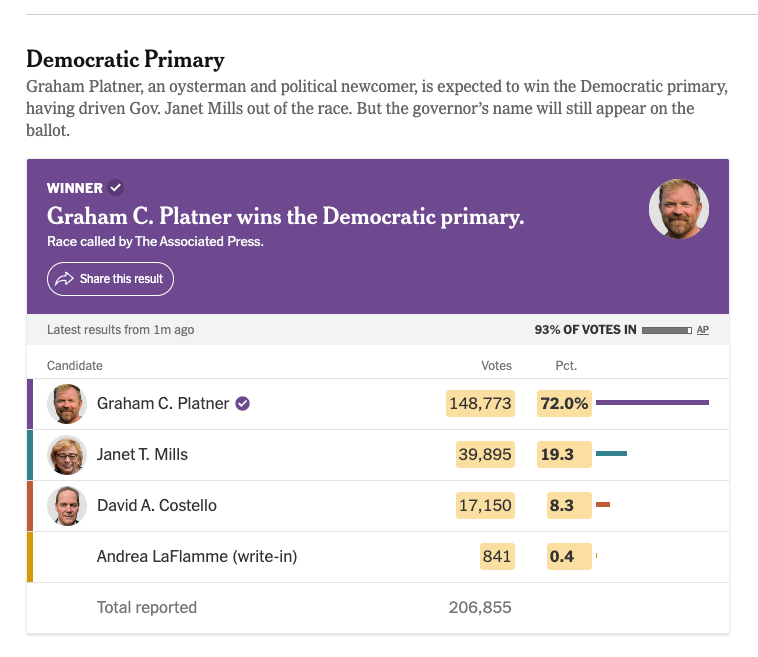
On Tuesday night, Graham Platner—a veteran, oyster farmer, and outspoken progressive populist—didn't just win the Democratic nomination for the U.S. Senate; he absolutely crushed it, amassing 72% of the vote. He will be facing off against Republican incumbent and supposed moderate Susan Collins in November.
And the donor class on both sides of the aisle is terrified.
Everything including the Kitchen Sink
For months, the mainstream media have treated Platner's campaign less like an election and more like a public witch hunt. They tried to throw everything they had at him. They dug up ancient Reddit posts, exploited a dark period of alcohol abuse and PTSD following his military service, tried to distract from the issues by focusing on consensual sexting text messages, and tried to cancel him based on tattoos.
The narrative was clear: This man is deeply flawed and dangerous. Don’t listen to him or his ideas, just go with a safe establishment candidate.
But the political and media establishment made a huge miscalculation: they thought that regular working-class voters would care more about decade-old text messages than they do about paying their rent or putting food on the table. While the likes of Hakeem Jeffries bristled at backing Platner, pundits praised Collins as a moderate (despite her long record voting for Trump’s agenda), and corporate media spent more time talking about tattoos than policies.
Fortunately, heavyweights like Bernie Sanders and Ro Khanna went out on a limb and stood by Platner despite the establishment’s full-on assault against him. And the public handed Platner a resounding win.
Rising above the manufactured scandals
One thing that Platner did right is that he didn't run away from his flaws. He owned his past, talking openly about his mental health journey, his alcoholism, his tattoo (which he says he didn’t know had Nazi symbolism—he had it removed once this was pointed out to him).
And perhaps more importantly, whenever the media would come after him with personal attacks, he would find a way to pivot back to the issues. His platform, which the media conveniently neglected to mention or included as a footnote, goes straight to the heart of the problem: preventing billionaires from buying elections and dismantling an economy rigged to benefit the Epstein class in favor of building a future for working families and small businesses.
The mainstream press and political establishment failed miserably despite going to their favorite playbook—manufactured character assassination. It’s obvious that Maine voters didn't want a saint anointed by the elite; they chose a fighter who, while flawed, actually acknowledges the economic anxiety in this country and has a plan to fix it.
The question is, what will the establishment throw at Platner as he faces off against Collins in the general election? Corporate Democrats have been losing the working class by offering nothing except “we’re not as bad as Trump”. The path forward is clear now. Platner just proved in resounding fashion that an economic-populist course is the way to win voters—and our country—back.
Posting through the Madness: Addressing the Hidden Costs of the AI Gold Rush
Speaking of fighting back against the elite, we actually saw a rare flash of legislative pushback right here in my own state of Tennessee this week. But as usual, the devil is in the details.
Earlier this week, I took to the “interwebs” to celebrate a rare legislative win for We the People. The Tennessee legislature passed HB 1847, a law requiring massive data centers to foot the bill for their own power infrastructure expansions. Utility companies, such as Memphis’s MLGW, are now prohibited from raising our monthly electricity rates to subsidize the extensive grid upgrades these tech giants envision.
On paper, it felt like a clear victory for consumer protection, which is what several articles touted. My post on Threads got a surprising 162 likes (instead of the usual single-digits I get on there) and some traction on other platforms, too. People obviously do not like AI companies mooching off of public utilities, and this bill takes a step in the right direction on that front.
But this is exactly why I love independent media and open dialogue. Several commenters on my Threads feed pushed back, with some excellent points that changed my perspective on the bill’s limitations. They brought the receipts on what this law conveniently leaves completely unaddressed.
This is exactly what social media should be: an actual exchange of ideas where we talk with each other — instead of screaming at each other — to become more informed and empowered.

Threads discussion: threads.com/@eclectic.misc/post/DZbXduuDak6
The Illusion of Corporate Accountability
While protecting customers from predatory utility hikes is undeniably good, the law completely sidesteps two key structural issues:
Community Choice: The bill regulates who pays for the infrastructure, but it does not to give local communities a voice or veto power over whether these massive data centers are allowed into their neighborhoods in the first place.
The Environmental Tax: Forcing a tech company to pay for its own power lines is just one consideration—it doesn’t stop data centers from potentially devastating local ecosystems, guzzling water, or polluting the air, all of which we are all too aware of in Memphis.
The Jet Engine in Memphis’s Backyard
If you live in the Memphis area, you can’t talk about data centers without addressing the absolute circus surrounding Elon Musk’s xAI “Colossus” facilities. Just this week, a group of local residents filed a class-action lawsuit against xAI, stating that the facility has subjected neighborhoods to “near-constant noise, vibrations, and nuisance-level harms” from over 50 roaring methane gas turbines.

You read that right — methane gas turbines near homes and elementary schools in one of the poorest neighborhoods in the area. This is the best the richest man in the world could be bothered to do.
So yes, Tennessee’s new law ensures that xAI has to pay for its own substation. As someone who strongly believes in consumer rights, this is an important development. But it leaves a large part of the issue unaddressed. It doesn’t address whether or not people want a data center in their backyard, regardless of who pays for it, and it doesn’t stop a multi-billionaire from running a de facto power plant that’s belching air and noise pollution into the community.
Huge shoutout to the Threads community for helping me delve deeper into this.
Squishy dumplings – a viral fidget fit for ADHD?
If reading about methane turbines belching fumes makes your brain hurt, like it does with me, you need a distraction from the craziness of the news. Which is part of the reason I finally cracked this week and bought myself a toy — I mean, a fidget!
Anyone who’s been online recently is probably all too aware that one of the latest trends is dumpling squishies (or squishy dumplings, I’ve seen it both ways). If you’re as clueless as I was until recently, this is what they look like:

I’m always on the cutting edge of trends and fashion (pauses for laughter), so after seeing what seemed like hundreds of ads for them on TikTok, I finally broke down and bought one — the one pictured above.
They’re nothing special. They’ll probably be forgotten in a month when the next trend comes along. And I don’t usually impulse buy. But my justification for purchasing it is that I was recently diagnosed with ADHD. And one thing that people with ADHD know is that fidget toys can be a huge help in terms of staying focused. According to CHADD (Children and Adults with Attention-Deficit/Hyperactivity Disorder):
Several research studies have confirmed what many people have experienced through fidgeting: Their ability to pay attention, their memory recall, and their problem-solving improves. Another study concluded that the fidgety behavior displayed by children and adults with ADHD may be an effort to increase their attention and alertness.
It’s pretty uncommon to be diagnosed with ADHD as an adult, but everything makes a LOT more sense to me now. I’ve disclosed that I’m bipolar before online, and even did a post in the previous incarnation of my blog about whether bipolar should count as neurodivergent.
But the bipolar diagnosis wasn’t explaining everything going on with me. I took a series of diagnostic tests, and my doctor said my results were not only very clear, they were “off the charts.” Yay?
Anyway, getting back to the squishy new addition to my family… There are a wide variety of fidgets out there — a fidget spinner was popular way back in the 2010s (time flies!) — but a lot of people are apparently using these dumpling squishies as fidgets now. I’ve never tried using a fidget before, so we’ll see how this works out for me. So far, I do find it soothing to use as I’m typing this segment up. Time will tell!
Besides buying a couple of books about ADHD (because I must know all the things), this dumpling is my first ADHD-related purchase. I’m still figuring a lot out as someone who is now officially “neurodivergent”, and maybe I’ll talk more about this some other time. But for now I can check “trendy fidget impulse buy” off my to-do list.
That’s it for this week’s edition of Finally Fridays. If you enjoyed this post, the best thing you can do is either share it or subscribe to get a heads-up each week when the next edition drops.
Hope you have a good weekend!